Convolutional Encoder/Decoder Architectures
%matplotlib inline
import numpy as np
import matplotlib.pyplot as plt
import seaborn as sns
import pandas as pd
plt.rcParams['xtick.direction'] = 'in'
plt.rcParams['ytick.direction'] = 'in'
plt.rcParams['axes.grid'] = True
plt.rcParams['axes.axisbelow'] = True
plt.rcParams['figure.dpi'] = 150
# Check available hardware
import torch
if torch.cuda.is_available():
print(f'GPU is available, using GPU {torch.cuda.get_device_name(0)}')
device = torch.device('cuda')
elif torch.mps.is_available():
print(f'Apple Metal Performance Shaders framework is available, using {torch.device("mps")}')
device = torch.device('mps')
else:
print(f'Hardware acceleration not available, using CPU')
device = torch.device('cpu')GPU is available, using GPU Tesla T4
Dataset: MNIST
For this example, we’ll use MNIST. But since we’re using torch now, we can use the MNIST located in torchvision
import torch
import torchvision
from torchvision.transforms import v2

transform = v2.Compose([
    v2.ToImage(),
    v2.ToDtype(torch.float32, scale=True)
])
mnist = torchvision.datasets.MNIST(root='~/scr10/', train=True, transform=transform, download=True)
mnist_test = torchvision.datasets.MNIST(root='~/scr10/', train=False, transform=transform, download=False)
from torch.utils.data import random_split
mnist_train, mnist_val = random_split(mnist, [0.8, 0.2])
print('Training dataset has length', len(mnist_train))
print('Training dataset has length', len(mnist_val))
print('Training dataset has length', len(mnist_test))
Training dataset has length 48000
Training dataset has length 12000
Training dataset has length 10000
x, y = mnist_train[0]
print('Input has shape', x.shape, 'and the output is', y)
Input has shape torch.Size([1, 28, 28]) and the output is 6
fig, ax = plt.subplots(2, 5, sharex=True, sharey=True)
ax = ax.flatten()
for ii in range(10):
    x, y = mnist_train[np.random.choice(len(mnist_train))]
    ax[ii].imshow(x.squeeze(), cmap='Greys')
    ax[ii].set(xticks=[], yticks=[])
plt.tight_layout()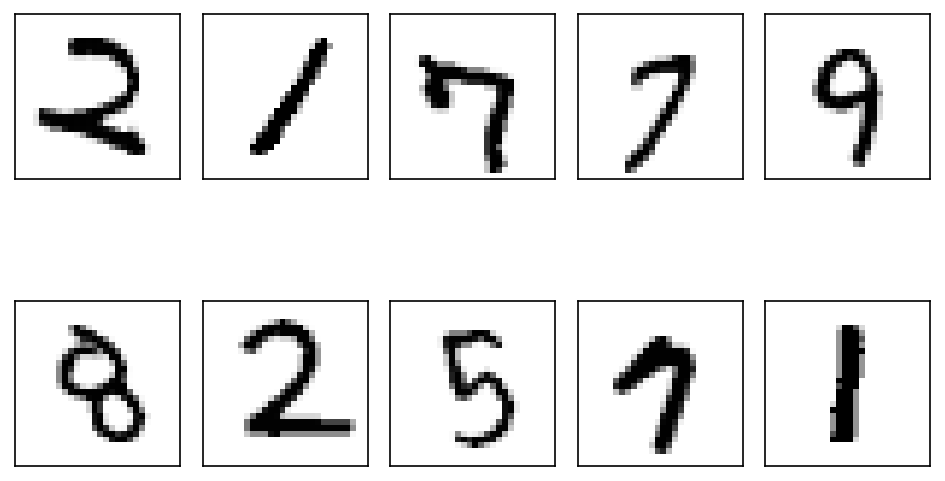
from sklearn.decomposition import PCA
pca = PCA(n_components=4, whiten=True)

X = mnist.data.reshape([60000, 784])
X = X / 255.
X_pca = pca.fit_transform(X)

y = mnist.targets

ax = plt.figure().gca()
for ii in range(10):
    mask = y == ii
    ax.scatter(X_pca[mask, 0], X_pca[mask, 1], s=1, label=ii)
ax.set(xlabel='Principal Component 1', ylabel='Principal Component 2')
ax.legend()
plt.tight_layout()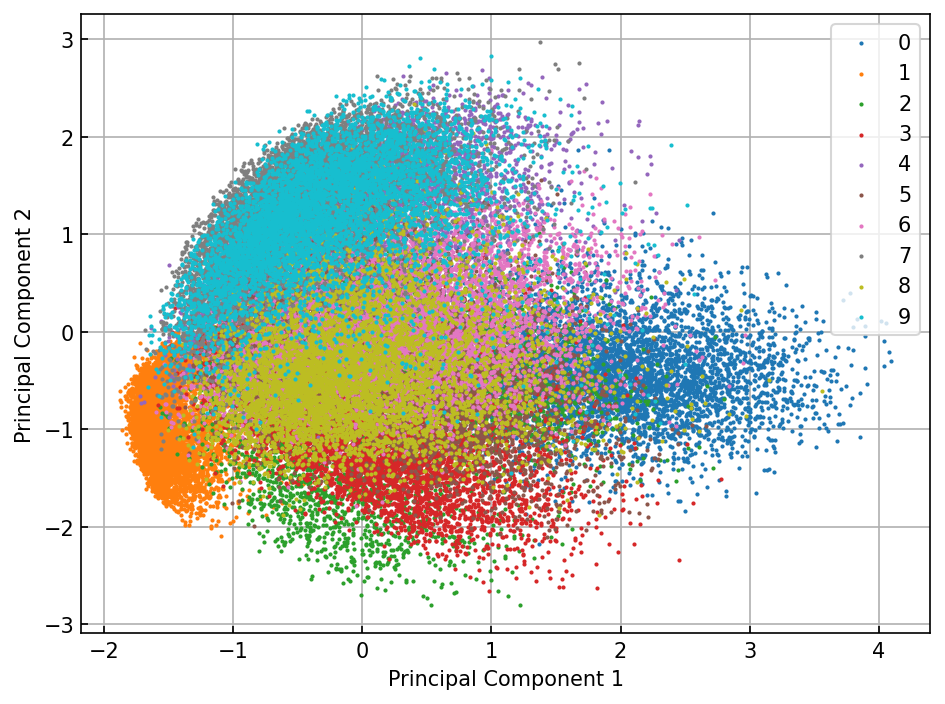
import seaborn as sns

df = pd.DataFrame({
    'z0': X_pca[:, 0],
    'z1': X_pca[:, 1],
    'z2': X_pca[:, 2],
    'z3': X_pca[:, 3],
    'y': y
})

sns.pairplot(df, hue='y', palette='tab10', plot_kws={'s': 5})
<seaborn.axisgrid.PairGrid at 0x7f2ac74281d0>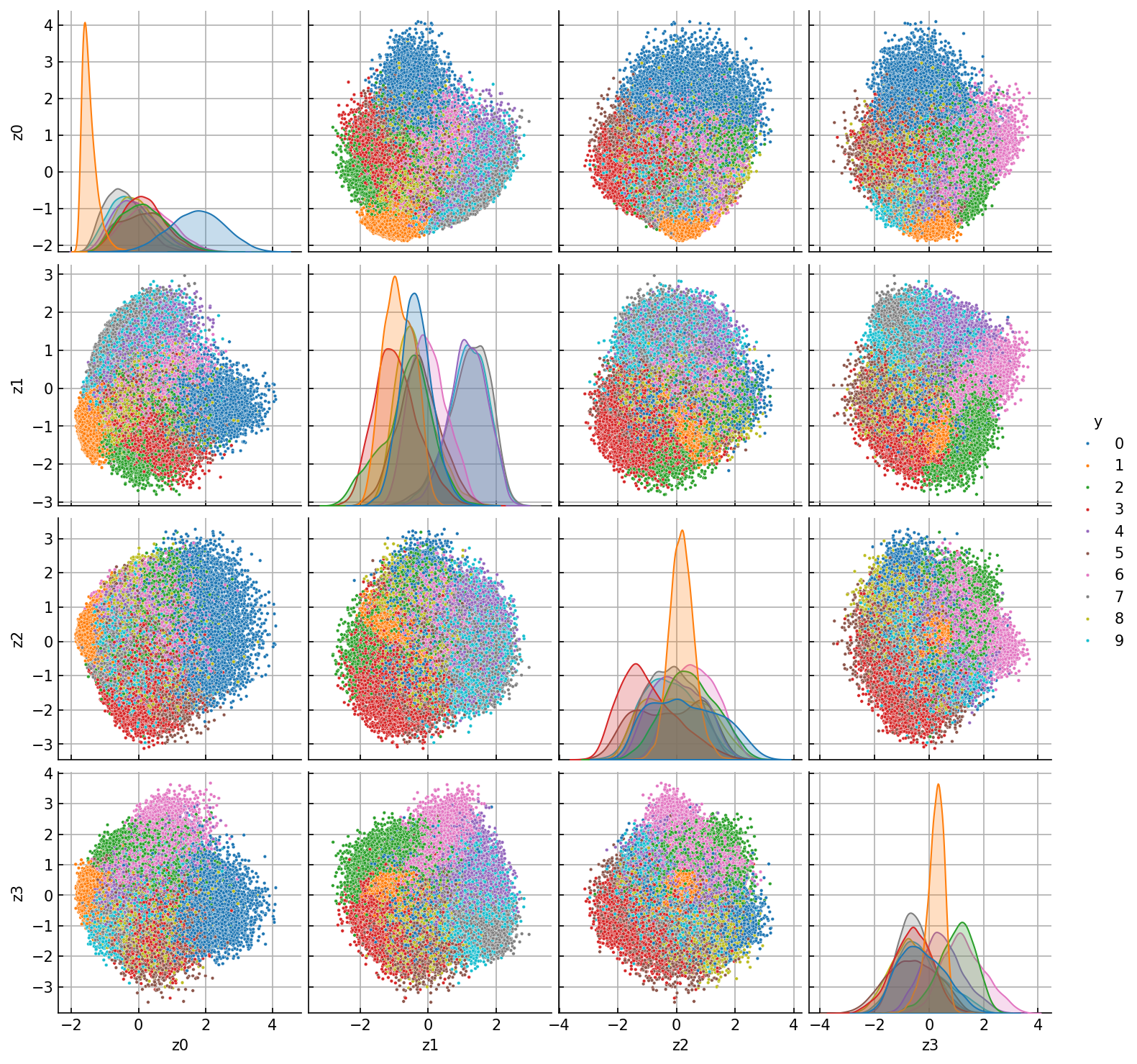
# Visualize principal components
fig, axes = plt.subplots(1, 4)
pcs = pca.components_.reshape([4, 28, 28])

for pc, ax in zip(pcs, axes):
    ax.imshow(pc, cmap='Greys')
    ax.axis('off')

CNN definition
import torch.nn as nn
import torch.nn.functional as F

class Encoder(nn.Module):
    def __init__(self):
        super().__init__()

        self.conv1 = nn.Conv2d(1, 16, kernel_size=3, padding=1)
        self.conv2 = nn.Conv2d(16, 32, kernel_size=3, padding=1)
        self.conv3 = nn.Conv2d(32, 64, kernel_size=3, padding=1)

        self.fc = nn.Linear(64*3*3, 3)

    def forward(self, x):
        # [B, 1, 28, 28]
        x = self.conv1(x)
        x = F.relu(x)
        x = F.max_pool2d(x, 2)

        # [B, 16, 14, 14]
        x = self.conv2(x)
        x = F.relu(x)
        x = F.max_pool2d(x, 2)

        # [B, 32, 7, 7]
        x = self.conv3(x)
        x = F.relu(x)
        x = F.max_pool2d(x, 2)

        # [B, 64, 3, 3]
        x = x.reshape([-1, 64*3*3])
        x = self.fc(x)
        return x

class Decoder(nn.Module):
    def __init__(self):
        super().__init__()

        self.conv1 = nn.ConvTranspose2d(16, 1, kernel_size=3, padding=1)
        self.conv2 = nn.ConvTranspose2d(32, 16, kernel_size=3, padding=1)
        self.conv3 = nn.ConvTranspose2d(64, 32, kernel_size=3, padding=1)

        self.fc = nn.Linear(3, 64*3*3)

    def forward(self, x):
        # [B, 10]
        x = self.fc(x)

        # [B, 64*3*3]
        x = x.reshape([-1, 64, 3, 3])

        x = F.interpolate(x, size=(7, 7))
        x = self.conv3(x)
        x = F.relu(x)

        x = F.interpolate(x, size=(14, 14))
        x = self.conv2(x)
        x = F.relu(x)

        x = F.interpolate(x, size=(28, 28))
        x = self.conv1(x)
        x = F.relu(x)

        return x

class Autoencoder(nn.Module):
    def __init__(self):
        super().__init__()
        self.encoder = Encoder()
        self.decoder = Decoder()

    def forward(self, x):
        z = self.encoder(x)
        x = self.decoder(z)
        return x, z
model = Autoencoder()
print(x.shape)
xp, zp = model(x[None])torch.Size([1, 28, 28])
Autoencoder training
from tqdm.notebook import tqdm, trange
from torch.utils.data import DataLoader

def train(model, loss_fn, optimizer, train_dataset, val_dataset,
          batch_size=32, num_epochs=100, num_workers=0, device=device):
    # Send model to correct hardware device
    model = model.to(device)

    # Create dataloaders for train/validation
    train_loader = DataLoader(train_dataset, batch_size=batch_size, num_workers=num_workers, shuffle=True)
    val_loader = DataLoader(val_dataset, batch_size=batch_size, num_workers=num_workers, shuffle=False)

    train_loss = []
    val_loss = []

    for epoch in range(num_epochs):
        train_loss_ = 0.
        model.train()
        for x, _, in tqdm(train_loader, leave=False):
            # Send x, y to GPU/TPU/etc.
            x = x.to(device)

            # Make a prediction, compute the loss
            x_pred, z_pred = model(x)
            loss = loss_fn(x_pred, x)

            # Backpropagate gradients, apply weight updates, reset gradients
            loss.backward()
            optimizer.step()
            optimizer.zero_grad()

            # Logging
            train_loss_ += loss.item() * x.shape[0]

        train_loss.append(train_loss_ / len(train_dataset))

        val_loss_ = 0.
        model.eval()
        with torch.no_grad():
            for x, y, in tqdm(val_loader, leave=False):
                # Send x, y to GPU/TPU/etc.
                x = x.to(device)

                # Make a prediction, compute the loss
                x_pred, z_pred = model(x)
                loss = loss_fn(x_pred, x)

                # Logging
                val_loss_ += loss.item() * x.shape[0]

            val_loss.append(val_loss_ / len(val_dataset))

        print(f'Epoch {epoch+1} | '
              f'Train loss { train_loss[-1]:.3f} | '
              f'Val loss { val_loss[-1]:.3f}'
        )

    return model, (train_loss, val_loss)
loss = nn.MSELoss()
optimizer = torch.optim.Adam(model.parameters(), lr=1e-3)
model, model_stats = train(
model,
loss,
optimizer,
mnist_train,
mnist_val,
num_epochs=10,
batch_size=64,
num_workers=4,
)Loading...
Loading...
Epoch 1 | Train loss 0.047 | Val loss 0.041
Loading...
Loading...
Epoch 2 | Train loss 0.039 | Val loss 0.038
Loading...
Loading...
Epoch 3 | Train loss 0.038 | Val loss 0.037
Loading...
Loading...
Epoch 4 | Train loss 0.037 | Val loss 0.037
Loading...
Loading...
Epoch 5 | Train loss 0.036 | Val loss 0.036
Loading...
Loading...
Epoch 6 | Train loss 0.036 | Val loss 0.035
Loading...
Loading...
Epoch 7 | Train loss 0.035 | Val loss 0.035
Loading...
Loading...
Epoch 8 | Train loss 0.035 | Val loss 0.035
Loading...
Loading...
Epoch 9 | Train loss 0.035 | Val loss 0.035
Loading...
Loading...
Epoch 10 | Train loss 0.035 | Val loss 0.034
fig, ax = plt.subplots(1, 1, sharex=True, figsize=(2.5, 2.5))

train_loss, val_loss = model_stats
ax.plot(train_loss, color='black', label='Train')
ax.plot(val_loss, color='red', label='Validation')
ax.set(xlabel='Epoch', ylabel='Loss')

fig.legend(*ax.get_legend_handles_labels(),
           loc='center left', bbox_to_anchor=[1, 0.5], framealpha=0)

plt.tight_layout()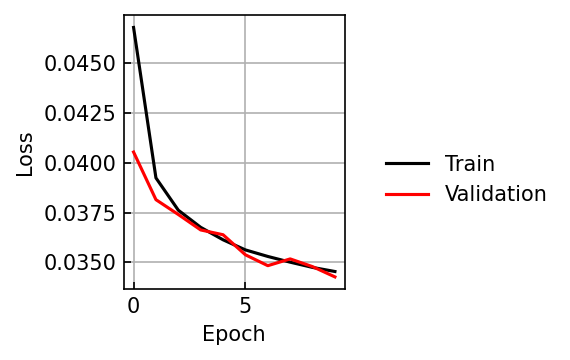
Inference
fig, ax = plt.subplots(2, 5, figsize=(10, 4), sharex=True, sharey=True)
for ii in range(5):
    xb, _ = mnist_test[ii]
    ax[0, ii].imshow(xb.squeeze().cpu().numpy(), cmap='Greys')
    with torch.no_grad():
        x_pred, z_pred = model(xb.to(device))
    ax[1, ii].imshow(x_pred.squeeze().cpu().numpy(), cmap='Greys')

ax[0,0].set_ylabel('Original')
ax[1,0].set_ylabel('Reconstructed')

for a in ax.flatten():
    a.set(xticks=[], yticks=[])
plt.tight_layout()
# Inference
model.eval()
test_loader = DataLoader(mnist_test, batch_size=128, shuffle=False)
with torch.no_grad():
    y_test = []
    z_test = []
    for xb, yb in tqdm(test_loader,leave=False):
        xb = xb.to(device)
        x_pred, z_pred = model(xb)

        y_test.append(yb.cpu().numpy())
        z_test.append(z_pred.cpu().numpy())

y_test = np.concatenate(y_test)
z_test = np.concatenate(z_test)
Loading...
import seaborn as sns

df = pd.DataFrame({
    'z0': z_test[:, 0],
    'z1': z_test[:, 1],
    'z2': z_test[:, 2],
    'y': y_test
})

sns.pairplot(df, hue='y', palette='tab10', plot_kws={'s': 5})
<seaborn.axisgrid.PairGrid at 0x7f2ac457c850>
Visualizing latent space
z = torch.FloatTensor([
    [1, 0, 0],
    [0, 1, 0],
    [0, 0, 1]
])
with torch.no_grad():
    y_fake = model.decoder(z.to(device))
    y_fake = y_fake.cpu().numpy()

fig, axes = plt.subplots(1, 3, sharex=True, sharey=True)

for yf, ax in zip(y_fake, axes.flatten()):
    ax.imshow(yf.squeeze(), cmap='Greys')
    ax.axis('off')
z0 = torch.linspace(-2, 2, 8)
z1 = torch.linspace(-2, 2, 8)
z = torch.stack(torch.meshgrid(z0, z1), dim=-1)
print(z[..., 0])
print(z[..., 1])
z = z.reshape([-1, 2])
z = torch.concat([z, torch.zeros_like(z[:, 0:1])], dim=-1)
print(z.shape)

with torch.no_grad():
    y_fake = model.decoder(z.to(device))
    y_fake = y_fake.cpu().numpy()

print(y_fake.shape)
tensor([[-2.0000, -2.0000, -2.0000, -2.0000, -2.0000, -2.0000, -2.0000, -2.0000],
[-1.4286, -1.4286, -1.4286, -1.4286, -1.4286, -1.4286, -1.4286, -1.4286],
[-0.8571, -0.8571, -0.8571, -0.8571, -0.8571, -0.8571, -0.8571, -0.8571],
[-0.2857, -0.2857, -0.2857, -0.2857, -0.2857, -0.2857, -0.2857, -0.2857],
[ 0.2857, 0.2857, 0.2857, 0.2857, 0.2857, 0.2857, 0.2857, 0.2857],
[ 0.8571, 0.8571, 0.8571, 0.8571, 0.8571, 0.8571, 0.8571, 0.8571],
[ 1.4286, 1.4286, 1.4286, 1.4286, 1.4286, 1.4286, 1.4286, 1.4286],
[ 2.0000, 2.0000, 2.0000, 2.0000, 2.0000, 2.0000, 2.0000, 2.0000]])
tensor([[-2.0000, -1.4286, -0.8571, -0.2857, 0.2857, 0.8571, 1.4286, 2.0000],
[-2.0000, -1.4286, -0.8571, -0.2857, 0.2857, 0.8571, 1.4286, 2.0000],
[-2.0000, -1.4286, -0.8571, -0.2857, 0.2857, 0.8571, 1.4286, 2.0000],
[-2.0000, -1.4286, -0.8571, -0.2857, 0.2857, 0.8571, 1.4286, 2.0000],
[-2.0000, -1.4286, -0.8571, -0.2857, 0.2857, 0.8571, 1.4286, 2.0000],
[-2.0000, -1.4286, -0.8571, -0.2857, 0.2857, 0.8571, 1.4286, 2.0000],
[-2.0000, -1.4286, -0.8571, -0.2857, 0.2857, 0.8571, 1.4286, 2.0000],
[-2.0000, -1.4286, -0.8571, -0.2857, 0.2857, 0.8571, 1.4286, 2.0000]])
torch.Size([64, 3])
(64, 1, 28, 28)
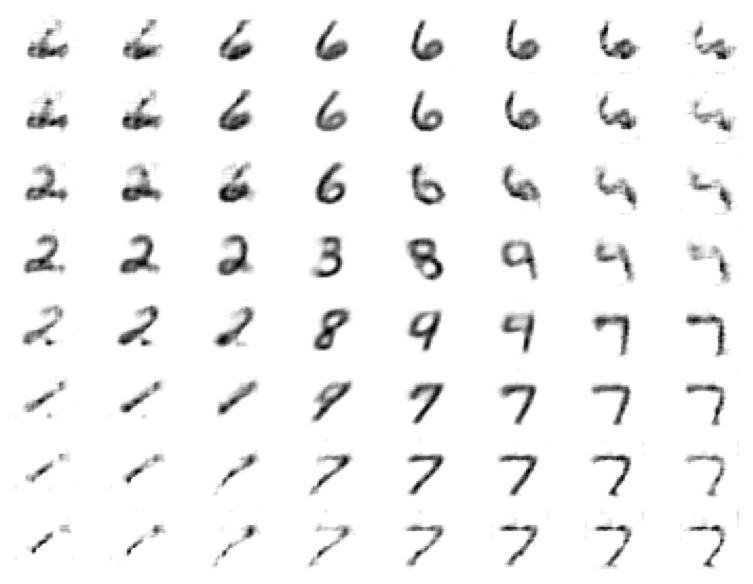
fig, axes = plt.subplots(8, 8, sharex=True, sharey=True)

for yf, ax in zip(y_fake, axes.flatten()):
    ax.imshow(yf.squeeze(), cmap='Greys')
    ax.axis('off')