Deep Neural Networks (PyTorch)
We’re going to spend today walking through PyTorch, a popular open-source library for deep learning. We’re talking about PyTorch because I prefer it. Others prefer TensorFlow, but that number is dwindling. Others prefer JAX, particularly in the research community, but it’s a small fraction.
In general, PyTorch has good documentation, good built-in functionality, and a wide network of compatible libraries that make Deep Learning easier to get up and running. It also exposes a bit more of the machinery to the user which makes it more customizable, particularly for things that aren’t vanilla supervised learning.
There are some subtle under-the-hood differences between PyTorch and TensorFlow. I may get into those details next time, or maybe not.
%matplotlib inline
import numpy as np
import matplotlib.pyplot as plt
import seaborn as sns
import pandas as pd
plt.rcParams['xtick.direction'] = 'in'
plt.rcParams['ytick.direction'] = 'in'
plt.rcParams['axes.grid'] = True
plt.rcParams['axes.axisbelow'] = True
plt.rcParams['figure.dpi'] = 150
%pip install torch# Check available hardware
import torch
if torch.cuda.is_available():
print(f'GPU is available, using GPU {torch.cuda.get_device_name(0)}')
device = torch.device('cuda')
elif torch.mps.is_available():
print(f'Apple Metal Performance Shaders framework is available, using {torch.device("mps")}')
device = torch.device('mps')
else:
print(f'Hardware acceleration not available, using CPU')
device = torch.device('cpu')PyTorch Tensors
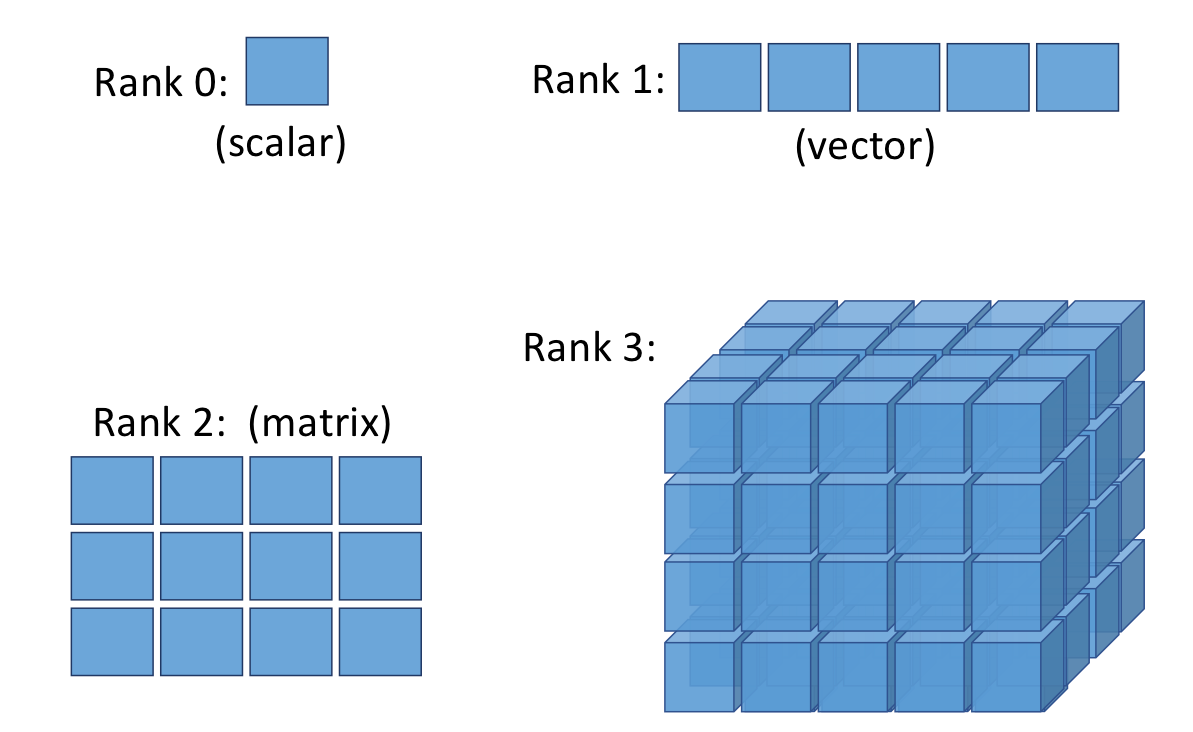
The basic unit of operation in (py)torch is a tensor. A scalar is a rank-0 tensor. It has no index. A vector is a rank-1 tensor that can be indexed as . A matrix is a rank-2 tensor that can be indexed as . A rank-3 tensor is similarly indexed as .
import numpy as np
a1 = [1, 2, 3]
a2 = np.array([1, 2, 3], dtype=np.float32)

# Turn these into torch tensors
t1 =
t2 =

print(t1)
print(t2)
# Tensors are a lot like numpy ndarrays
a3 = np.eye(3, dtype=np.float32)
print(a3)
print('nd-array attributes:', a3.shape, a3.dtype)
# Turn this into a torch tensor and print out some attributes
t3 = torch.from_numpy(a3)
print(t3)
print('tensor attributes:', )# tensor operations
# Resize
t3_1 =
print(t3_1)
# Data type conversion
t3_2 =
print(t3_2)
# Send to other device
t3_3 =
print(t3_3)Big Tensors
Tensors can get very large and have a large number of indices. For example, a batch of images might have 4 indices:
t_big = torch.rand(1, 3, 8, 8)

%matplotlib inline
import matplotlib.pyplot as plt
ax = plt.figure().gca()
ax.imshow(t_big.squeeze().permute(1, 2, 0))
Fun with tensors
We can do a lot of normal mathematical and array operations with tensors just as we would numpy arrays
t1 = torch.rand(3, 2)
t2 = torch.normal(mean=0, std=1, size=(3, 2))

# Elementwise product
t3 =
print('Elementwise product', t3.shape, '\n', t3)

# Mean along dimension
print()
t4 =
print('Dimension mean', t4.shape, '\n', t4)

# Matrix multiplication
print()
t5 =
print('Matrix multiplication', t5.shape, '\n', t5)

# L2 Norm
print()
t6 =
print('L2 norm', t6.shape, '\n', t6)
print('For elements t1:', t1.shape, 'and t2:', t2.shape)
# Tensor concatenation
print()
t3 =
print('concat(t1, t2):', t3.shape)
# Tensor splitting
print()
t4, t5 =
print('split t3 at index 2 on dimension 1:')
print('\tFirst part', t4.shape, ' = t1?', torch.all(t1 == t4))
print('\tSecond part', t5.shape, '= t2?', torch.all(t2 == t5))
# Tensor stacking
print()
t6 =
print('stack(t1, t2):', t6.shape)Torch Datasets and DataLoaders
Torch builds in a lot of functionality that we need for training neural networks beyond the networks themselves (which we will get to). For example, data loading pipelines to serve tensors to the model during training
from torch.utils.data import Dataset
class BasicDataset(Dataset):
    def __init__(self, x, y):

    def __len__(self):
        """ So torch code knows how many examples to fetch from the dataset """

    def __getitem__(self, idx):
        """ So torch code knows how to access the underlying data """

# A torch Dataset can be accessed just like an array now
dataset = BasicDataset(
    x=torch.rand([10, 4]),
    y=torch.arange(10, dtype=torch.long)
)

print(f"The size of the dataset is {len(dataset)}")
print(f"The 4th element of the dataset is {dataset[3]}")
from torch.utils.data import TensorDataset
tensor_dataset = from torch.utils.data import DataLoader
# Initialize a loader
loader =
# Iterate through the loader# Iterate through multiple epochsMultiprocessing while data loading
import os
print(f'Environment has {os.cpu_count()} available cores')
dataset = TensorDataset(
torch.rand([8192, 3, 128, 128]),
torch.arange(8192, dtype=torch.long)
)
print(len(dataset))from time import time
# Create a loader with batch_size 32, no multi-processing
# Iterate through the loader and time each epochfrom time import time
# Create a loader with batch_size 32, num_workers > 0
# Iterate through the loader and time each epochGradient descent
Linear regression
Just as a teaser, let’s see how to do regression using gradient descent and PyTorch. Start by creating a dataset in numpy
X = np.random.uniform(size=(10, 1)).astype(np.float32) * 10
noise = np.random.normal(0, 0.25, size=X.shape).astype(np.float32)

y = 2. * X + 1. + noise

ax = plt.figure().gca()
ax.scatter(X, y)
ax.set(xlabel='x', ylabel='y')
from torch.utils.data import TensorDataset, DataLoader
# Convert numpy arrays into torch tensors
X_train = torch.from_numpy(X)
y_train = torch.from_numpy(y)
# A TensorDataset holds the torch tensors
train_dataset = TensorDataset(X_train, y_train)
# A dataloader serves up the data to the model
train_loader = DataLoader(train_dataset, batch_size=1, shuffle=True)def mse_loss(y_true, y_pred):
""" Loss function """
return (y_true - y_pred).pow(2).mean()
def model(x):
""" Model is linear equation """
return x @ slope + intercept
# Initialize model weights
slope =
intercept = lr = 0.01 # Learning rate
num_epochs = 100 # Run for 100 epochs
log_epochs = 10 # Print out loss every 10 epochs
for epoch in range(num_epochs):
epoch_loss = 0.
for x_batch, y_batch in train_loader:
# Make a prediction
# Compute the loss
# Compute and backpropagate gradients
# Apply the weight updates
# Update the running loss tally
epoch_loss += loss.item()
if epoch % log_epochs == 0:
print(f"Epoch {epoch}: loss = {epoch_loss:.3f}")print(f"Fit parameters: slope = {slope.item():.3f}, intercept = {intercept.item():.3f}")
ax = plt.figure().gca()
ax.scatter(X, y, label='Data')
xx = torch.linspace(0, 10, 5, dtype=torch.float32, requires_grad=False)
yy = model(xx[:, None])
ax.plot(xx.numpy(), yy.detach().numpy(), color='black', label='Model')
ax.set(xlabel='x', ylabel='y');
ax.legend()How does this work?
PyTorch stores an attribute alongside each tensor called grad. We’ll talk about this next class in more detail. But in a nutshell, this piece is populated when we call backward() after making the forward pass.
# Initialize the model weights
slope = torch.randn(1, requires_grad=True)
intercept = torch.zeros(1, requires_grad=True)

for x_batch, y_batch in train_loader:
    print(slope.grad, intercept.grad)

    y_pred = model(x_batch)
    print(slope.grad, intercept.grad, y_pred.grad_fn)

    loss = mse_loss(y_batch, y_pred)
    print(slope.grad, intercept.grad, loss.grad_fn)

    loss.backward() # This computes the gradients for our relevant tensors
    print(slope.grad, intercept.grad)

    break
A more PyTorch way of doing it
from torch.nn import Linear, MSELoss
from torch.optim import SGD

# Create a nn.Linear model that maps x -> y with a bias term
model =

# Put the model on the hardware accelerator (GPU, TPU, etc.)

# Use MSE Loss in torch

# Compute weight updates using stochastic gradient descent


for epoch in range(num_epochs):
    epoch_loss = 0.
    for x_batch, y_batch in train_loader:
        # Send x, y to the model device

        # Make the prediction

        # Compute the loss

        # Compute and backpropagate the gradients

        # Apply the weight updates using the optimizer

        # Zero out the gradients for the next pass

        epoch_loss += loss.item()

    if epoch % log_epochs == 0:
        print(f"Epoch {epoch}: loss = {epoch_loss:.3f}")
print(f"Fit parameters: slope = {slope.item():.3f}, intercept = {intercept.item():.3f}")
ax = plt.figure().gca()
ax.scatter(X, y, label='Data')
with torch.no_grad():
xx = torch.linspace(0, 10, 5, dtype=torch.float32, device=device)
yy = model(xx[:, None])[:, 0]
ax.plot(xx.cpu().numpy(), yy.cpu().numpy(), color='black', label='Model')
ax.set(xlabel='x', ylabel='y');
ax.legend()Polynomial regression
How would you implement a model to fit the following dataset?
X = np.random.uniform(size=(32, 1)).astype(np.float32) * 10
noise = np.random.normal(0, 0.5, size=X.shape).astype(np.float32)

y = 0.5 * X**2 + 2. * X + 1. + noise

ax = plt.figure().gca()
ax.scatter(X, y)
ax.set(xlabel='x', ylabel='y')
Neural networks
Let’s train a neural network to fit the XOR dataset
Dataset creation
def make_xor_dataset(N=100, random_seed=42):
    np.random.seed(random_seed)
    X = np.random.randn(N, 2).astype(np.float32)
    y = np.logical_xor(X[:, 0] > 0, X[:, 1] > 0)
    y = np.where(y, 1, 0)
    return X, y

X, y = make_xor_dataset(N=1024, random_seed=42)
X_test, y_test = make_xor_dataset(N=64, random_seed=1)

ax = plt.figure().gca()
ax.scatter(X[:, 0], X[:, 1], c=y, marker='o', cmap='bwr')
ax.scatter(X_test[:, 0], X_test[:, 1], c=y_test, marker='d', cmap='bwr')
ax.set(xlabel='$x_0$', ylabel='$x_1$', aspect='equal');
from torch.utils.data import TensorDataset, DataLoader, random_split
# Create a TensorDataset
train_val_dataset =
# Perform a train/validation split
train_dataset, val_dataset =
# Create a test dataset as well
test_dataset =
print(f"Train: {len(train_dataset)}, Val: {len(val_dataset)}, Test: {len(test_dataset)}")Model implementation
import torch.nn as nn
# Create a model using torch.nn.Sequential
model = nn.Sequential(

)
model
import torch.nn as nn
import torch.nn.functional as F
# Create a model by extending torch.nn.Module
class Model(torch.nn.Module):
""" A torch.nn.Module object implements a forward pass
Torch, under the hood, takes care of everything else
"""
def __init__(self, input_size=2, hidden_size=128, output_size=2):
super().__init__()
def forward(self, x):
model = Model(
input_size=X.shape[1],
hidden_size=128,
output_size=2, # 2 classes
).to(device)
modelTraining loop
from tqdm import tqdm, trange

def train(model, loss_fn, optimizer, train_dataset, val_dataset, batch_size=32, max_epochs=100):
    train_loss, train_acc = [], []
    val_loss, val_acc = [], []

    # Create dataloaders for train/validation
    train_loader =
    val_loader =

    pbar_epoch = trange(num_epochs)
    for ii in pbar_epoch:
        train_loss_ = 0.
        train_acc_ = 0.
        for x, y, in train_loader:
            # Send x, y to GPU/TPU/etc.

            # Make a prediction, compute the loss

            # Backpropagate gradients, apply weight updates, reset gradients

            # Logging
            train_loss_ += loss.item() * x.shape[0]
            train_acc_  += (torch.argmax(y_pred, dim=1) == y).float().sum().item()

        train_loss.append(train_loss_ / len(train_dataset))
        train_acc.append(train_acc_ / len(train_dataset))

        val_loss_ = 0.
        val_acc_ = 0.
        with torch.no_grad():
            for x, y, in val_loader:
                # Send x, y to GPU/TPU/etc.

                # Make a prediction, compute the loss

                # Logging
                val_loss_ += loss.item() * x.shape[0]
                val_acc_  += (torch.argmax(y_pred, dim=1) == y).float().sum().item()

            val_loss.append(val_loss_ / len(val_dataset))
            val_acc.append(val_acc_ / len(val_dataset))

        pbar_epoch.set_postfix(
            epoch=f"{ii+1:03d} / {num_epochs:03d}",
            train_loss=f"{train_loss[-1]:.3f}",
            train_acc=f"{train_acc[-1]:.3f}",
            val_loss=f"{val_loss[-1]:.3f}",
            val_acc=f"{val_acc[-1]:.3f}")

    return model, (train_loss, train_acc, val_loss, val_acc)

loss_fn =
optimizer =
model, model_stats = train(model, loss_fn, optimizer, train_loader, val_loader)Analysis
def loss_accuracy_plot(train_loss, train_acc, val_loss, val_acc):
    fig, ax = plt.subplots(1, 2, sharex=True, figsize=(5, 2.5))

    ax[0].plot(train_loss, color='black', label='Train')
    ax[0].plot(val_loss, color='red', label='Validation')
    ax[0].set(xlabel='Epoch', ylabel='Cross Entropy Loss')

    ax[1].plot(train_acc, color='black', label='Train')
    ax[1].plot(val_acc, color='red', label='Validation')
    ax[1].set(xlabel='Epoch', ylabel='Accuracy')

    fig.legend(*ax[1].get_legend_handles_labels(),
            loc='center left', bbox_to_anchor=[1, 0.5], framealpha=0)
    return fig

loss_accuracy_plot(*model_stats)
plt.tight_layout()
from matplotlib.colors import ListedColormap
def plot_decision_boundary(ax, X, y, model, d=0.02, colors=['blue', 'red']):
x1, x2 = np.meshgrid(
np.arange(X[:, 0].min()-10*d, X[:, 0].max()+10*d, d),
np.arange(X[:, 1].min()-10*d, X[:, 1].max()+10*d, d),
)
with torch.no_grad():
x_grid = np.stack([x1.ravel(), x2.ravel()]).T
x_grid = torch.from_numpy(x_grid.astype(np.float32)).to(device)
y_model = model(x_grid).cpu().numpy()
y_model = np.argmax(y_model, axis=-1)
y_model = y_model.reshape(x1.shape)
y_pred = model(torch.from_numpy(X).to(device)).cpu().numpy()
y_pred = np.argmax(y_pred, axis=1)
pred_mask = y_pred == y
cmap = ListedColormap(colors)
im=ax.pcolormesh(x1, x2, y_model, alpha=0.5, cmap=cmap)
for ii, label in enumerate(np.unique(y)):
label_mask = y == label
ax.scatter(X[label_mask & pred_mask, 0], X[label_mask & pred_mask, 1],
facecolor=colors[label], edgecolor=colors[label])
ax.scatter(X[label_mask & ~pred_mask, 0], X[label_mask & ~pred_mask, 1],
facecolor='white', edgecolor=colors[label])
return ax
ax = plt.figure().gca()
plot_decision_boundary(ax, X_test, y_test, model)Activation functions
class LinearModel(torch.nn.Module):
    def __init__(self, input_size=2, hidden_size=128, output_size=2):
        super().__init__()

    def forward(self, x):

class TanhModel(torch.nn.Module):
    def __init__(self, input_size=2, hidden_size=128, output_size=2):
        super().__init__()

    def forward(self, x):

class ReLUModel(torch.nn.Module):
    def __init__(self, input_size=2, hidden_size=128, output_size=2):
        super().__init__()

    def forward(self, x):
for label, model_type in zip(['Linear', 'Tanh', 'ReLU'],
[LinearModel, TanhModel, ReLUModel]):
model = model_type(
input_size=X.shape[1],
hidden_size=128,
output_size=2, # 2 classes
).to(device)
loss_fn = torch.nn.CrossEntropyLoss()
optimizer = torch.optim.Adam(model.parameters(), lr=0.001)
model, model_stats= train(model, loss_fn, optimizer, train_loader, val_loader)
fig = loss_accuracy_plot(*model_stats)
fig.suptitle(label + " Activation")
plt.tight_layout()
ax = plt.figure().gca()
plot_decision_boundary(ax, X_test, y_test, model)
ax.set_title(label + " Activation")
plt.show()Deep MLP
class DeepMLP(torch.nn.Module):
    def __init__(self, input_size=2, hidden_size=128, output_size=2):
        super().__init__()

    def forward(self, x):

model = Model(
    input_size=X.shape[1],
    hidden_size=128,
    output_size=2, # 2 classes
).to(device)

loss_fn = torch.nn.CrossEntropyLoss()
optimizer = torch.optim.Adam(model.parameters(), lr=0.001)

model
model, model_stats= train(model, loss_fn, optimizer, train_loader, val_loader)
loss_accuracy_plot(*model_stats)
plt.tight_layout()
ax = plt.figure().gca()
plot_decision_boundary(ax, X_test, y_test, model)